
Mark Shea ends his sabbatical briefly to say this. It is worth reading.
Monday, March 28, 2005


Easter Monday
He is Risen!
This morning we rejoice that Terri Schiavo has been given the last sacrament – spiritual food for her next journey.
Our pastor, Fr. John O’Holohan, SJ, talked on Easter of three snapshots of the world on this Easter morn. The first was that of the Holy Father, silently blessing the crowds, working in his last days, and suffering for the Church. The second was another person getting ready to die, but she has been told that her life is worthless as she is starved to death in Florida. The third snapshot was the war scenes in Iraq. Father made the point that the Resurrection gave meaning and hope to all – even in these times which may seem hopeless to some.
Mrs. Curley and I need to remember this last. We were up late last night discussing the future, the system, politicians. I read this morning in a little book, "The End of the Modern World", by Romano Guardino the following:
"The crisis which confronts democracy has arisen because it received its historical imprint from the attitudes of a personality culture. Thus democratic values presumed a small population. ...Man's relations with nature have been altered radically, have become indirect. The old immediateness has been lost, for now his relations are transmitted by mathematics or by instruments. Abstract and formalized, nature has lost all concreteness' having become inorganic and technical, it has lost the quality of real experience. ... Man can no longer experience the work he does; he can only calculate its possibilities and control its effects from a distance. This condition raises graver problems. Basically man becomes himself, is himself through his experiences. What can he be, however, if he can no longer involve himself "sensibly" in the work he does?"
What has this to do with Terri Schiavo? First, we see that democracy has run amok. The system is "god". No president, governor, congressman dare challenge it. The laws are too many and complex for anyone in the country to understand - because they encompass all and every situation - and no man supercedes what the 'system' has put in place
Further, if man has lost his identity, he has lost his place in the world. He no longer understands the cycle of life, the cycle of nature, the redemptive value of suffering - even though it sits before him. A woman suffers to bring forth new life and joy! Yet even this suffering has been profaned by our society. (Note I don't say 'culture' as we have none.).
So many people have bought the 'quality of life' product - that they are of no use past a certain age, or wellness. They have been convinced (or have convinced themselves) that to be a burden on another, on our children, due to age or illness is the ultimate evil! Oh no!
Please, O Lord, let me have these burdens! Please, O Lord, let my children have these burdens!
From the small holding in Bethune ...
Oremus pro invicem!
Saturday, March 26, 2005
The final days
I have not said much here on Terri Schiavo. Many others have done much better than I could have. But we have been praying. My boys have asked every morning if there is anything new. A few times Mrs. Curley and I have heard them say an extra Rosary after we have shuffled them off to bed. More rosaries are certainly needed. Mrs. Curley has been very upset at the lack of humanity our society seems to have come to. My 5 year old, who has some awareness of all this due to family discussions, asked why we don't just go down and rescue her (and kill the bad guys). Mr. Luse asks a similar question of Mr. Bush: here.
Jeff at El Camino Real says here that "our 'system' in the United States is damaged beyond repair. Yes, beyond repair. What a bloody tangled mess."
Over at Caelum et Terra, one wonders: Nevertheless, the boy who cried wolf was eventually correct. I don't think that the almost certainly impending death of Terri Schiavo means that the government is going to start rounding up Christians or implementing a program of euthanasia for the disabled. But I am concerned that we have taken a decisive step in that direction, a step big enough that historians might one day see it as a useful marker, like the burning of the Reichstag, of a decisive change. We are witnessing the government-ordered starvation of an innocent person.
Indeed will this be a marker? Popular opinion is with Michael Schiavo. It is the opinion of a society which has lost its way, which has no hope.
We have been letting people be starved to death for years. However this is one of the few cases, where there has been someone to speak for the victim of our modern "compassion and justice". Our outrage can not die when Terri Schiavo dies, as she most likely will later this week.
Once more battle lines have been drawn, we cannot let the army disband as it usually does. However, we must remember that prayer, prayer, and more prayer must precede and accompany actions.
Some of us do live in hope - the hope of the Resurrection which we celebrate tomorrow. We must somehow find a way to bring this hope to the rest of society. John Paul in his suffering is the best witnes - but eyes are closed. We must pray all the harder. The temptation is to act, and act and act - but only God can change hearts - our actions can not. We must pray and fast and realize these times are cause for heroic prayer.
From the small holding in Bethune ...
Oremus pro invicem!
Tuesday, March 22, 2005
Passion Play Pictures
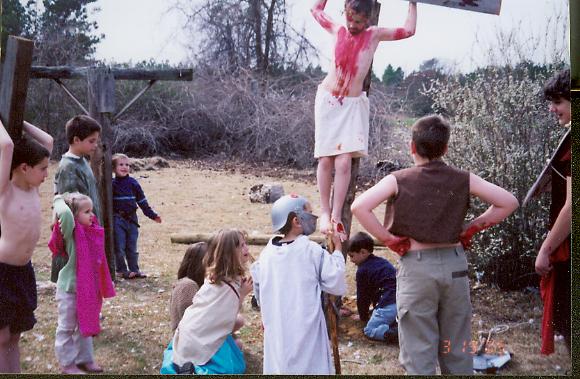
On the cross.
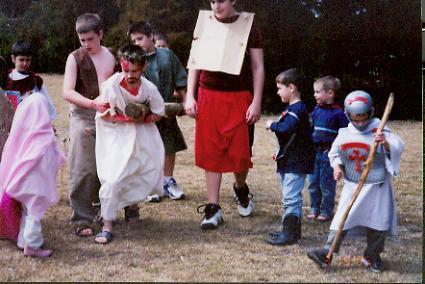
I have uploaded these pictures (with great difficulty) mostly for my family and the families of the other children who participated in the Passion Play. I note that there was no adult involvement in this play except for the placing of the cross in the ground which took three of us. The 11-year-old director has not seen Mel Gibson's movie.
Have a prayful Holy Week.
From the small holding in Bethune...
Oremus pro invicem!



Monday, March 21, 2005
Holy Week
It will be a light blogging week. I am shutting down the store on Wednesday afteroon until Easter Tuesday - so my time at the computer will be limited. By the way, I know that Requiem Press has 'finally arrived' - one of our books showed up on a used book search on the internet.
The children and their friends put on their annual 'Passion Play' on Saturday. If I get the pictures developed I may try to put one or two on the site - if I can figure it out.
We put a 110 square foot addition onto the chicken coop this weekend as planned in my last post. It has helped dog Challenger. I took him for a long walk/run on Sunday. He seems almost back to normal after being separated from those chickens.
From the small holding in Bethune...
Oremus pro invicem!
Friday, March 18, 2005
Catching Up
This will be a short one. I am still trying to catch up with the few comments made below when I was having trouble with the ‘blogger’.
A few articles of interest – most of which I am late in recommending:
New evidence and images on the Holy Shroud of Turin - here
Important article on torture from Mark Shea, online at Crisis – here
Most recent issue of Catholic World Report has an eye-opening article on “brain death” and organ donation. It is not online (that I know of), but here is an brief excerpt:
Terry Shiavo – while we have not mentioned her before on this blog, but she has been in our prayers, and is especially today.
It has been so busy at Requiem Press these past few weeks, as we have a new release due to be available on Easter Monday and we have made arrangements to carry a book, a prayer book, in limited quantity which is in its 11th edition since 1971. Hopefully the website will be updated on Monday with this news.
Finally, today is a bit unusual. Most of the day will be taken up extending our chicken coops. We are having problems with hens attacking each other and roosters attacking each other. This being the case even though we have much more than the recommended square footage per bird. We need more separation. In addition, our dog Challenger (of slaughter fame – see October archives) has not been himself since the chickens have reached maturity. He sits all day by the fence bordering the coop barking and/or licking his lips. He doesn’t want to go exercise or run in the woods anymore. We need to do something about this.
But first, off to the Holy Sacrifice….
From the small holding in Bethune…
Oremus pro invicem!
Thursday, March 17, 2005
Happy St. Patrick's Day
Growing up we played Irish music (really American-Irish music) and marched around the house and danced. My sister Judy drew an almost lifesize picture of St. Patrick and I drew the Irish coat of arms on a piece of wood mounted to a hockey stick. These two items were used to lead the parade. My grandmother - Nana - had come from the Connemara country and had stowed away on a ship at 12 coming to America. My grandfather was Irish, but he died so young we know almost nothing about him. I used to spend hours discussing Ireland with Nana. She died when I was in 4th grade. She left some $400 to me so I could visit the "old country". I never have, but hope to someday.
Today we will stop work a little early and break the somberness of Lent for a couple hours in the evening to sing some songs and dance a little.
Here is today's installment from O'Reilly's "Lives". It is from the Preface:
In no country was this practice of preserving the memorials of the saints more carefully observed than in Ireland. Our earliest and most authentic records since the days of St. Patrick are the lives of our saints; and from Jocelyn to Colgan to record their deeds was a labor of love. It was a remarkable fact that, in all these collections, up to the sixteenth century one class of saints found no representatives. The Church of Ireland had produced a "glorious choir of apostles" who bore the good tidings to many a distant land; the "number of her prophets who uttered praise" was not small; but she numbered in her calendar no representative of "the white-robed army of martyrs." By a singular prerogative her conversion had not cost the life of a single one of her teachers, and it seemed probable that, were she left to herself; no blood of her children, shed for the faith, would ever stain her soil. But the litany of her saints was to be completed, and he who was the "Master of her apostles," the "Teacher of her evangelists," the "Purity of her virgins," was also to be the "Light of her confessors" and the "Strength of her martyrs;" and the church, whose foundations had been laid in peace, was to see her persecution-shaken walls cemented and rebuilt with the blood of her martyrs.
The sixteenth century saw in Ireland the commencement of a persecution which, gradually increasing in intensity, culminated in the middle of the seventeenth in what was probably the most exterminating attack ever endured by a Christian church. The fanatical followers Of Mohammed, in the seventh century, propagated their faith by the sword; but the hordes of Cromwell abandoned the attempt to make the Irish converts, and turned all their energies to blotting out Catholicity in Ireland by the destruction of the Irish race: the Irish were recognized as ineradicably Catholic, and were slain or banished to wildernesses where it was believed they must become extinct. While this persecution was one mainly and essentially of Catholicity, it was embittered and prolonged by every other element which could exacerbate and increase its ferocity; the differences of race, of conquest, of government, all added their elements of bitterness to intensify and prolong the strife.
From the small holding in Bethune on this feast of St. Patrick ....
Oremus pro invicem!
Wednesday, March 16, 2005
Mysterious Happenings
Wrote a long post early yesterday but it got lost in blog-land. I couldn't get in to my blog all day today, even to leave myself an anonymous comment - until just now when of course I want to hit the hay. But I will take a moment to excerpt a little more from O'Reilly's "Lives". This one is for Krystle...
THE FRANCISCAN NUNS OF GALWAY:
IN 1712, when Edward Eyre, Mayor of Galway, was directed to suppress the nunneries in that town, " Dr. John Burke, then provincial of the Franciscans in Ireland, of which order the nuns were, obtained permission from Dr. Edmund Byrne, titular Archbishop of Dublin, to admit them into his diocese, hoping they would be less noticed there than in a place upon which government kept so strict an eye as Galway. A few of these ladies were accordingly translated to Dublin ; but they had scarcely reached the city, when the lords-justices received information of their arrival, and immediately issued orders for their apprehension, in consequence of which several were taken in their conventual habits. A proclamation was then issued, dated 20th September of that year, to apprehend said John Burke, Dr. Byrne, and Dr. Nary, as popish priests attempting to exercise ecclesiastical jurisdiction contrary to the laws of this kingdom; and it was ordered that all laws in force against the papists should be strictly carried into execution. Such were the fears and alarms caused by the arrival of a few women in the capital, as if the circumstance had been sufficient to over-turn the government …
From the small holding in Bethune...
Oremus pro invicem!
Monday, March 14, 2005
As St. Patrick's Day is coming ...
When Number One daughter made a surprise visit this weekend, she brought me a nice (if temporary) present. She checked out of the Christendom College library a copy of "Lives of the Irish Martyrs and Confessors" by Myles O'Reilly (pub. 1878). I would love to have my hands on a copy of this treasure - permanently. (In fact Requiem Press would love to reprint this classic either in parts or in its entirety. If it be God's will - we will get around to it.) Here is a sample:
CROMWELL landed on our shores in July, 1649, firmly resolved to acquire popularity among his fellow-Puritans by the extermination of the Irish papists. On his arrival in Dublin he addressed his soldiers, and declared that no mercy should be shown to the Irish, and that they should "be dealt with as the Canaanites in Joshua's time."
Drogheda was first attacked. It was defended by 3000 good troops, commanded by Sir Arthur Ashton, a Catholic. Three times did they repel the assaults of their 10,000 besiegers. At length, seeing further resistance useless, they surrendered on terms. Cromwell, writing to the Parliament, makes it a boast that, despite the promised quarter, he himself gave orders that all should be put to the sword; ("Our men were ordered by me to put them all to the sword." — Cromwell's Letter) and, in his Puritanical cant, he styles that brutal massacre a righteous judgment of God upon the barbarous wretches; a great mercy vouchsafed to us; a great thing, done, not by power or might, but by the spirit of God. The slaughter of the inhabitants continued for five days, and the Puritan troops spared neither age nor sex, so much so that the Earl of Ormond, writing to the secretary of Charles II, to convey the intelligence of the loss of Drogheda, declares that "Cromwell had exceeded himself, and anything he had ever heard of, in breach of faith and bloody inhumanity;" and the Parliamentarian General Ludlow speaks of it as an extraordinary severity. The church of St. Peter, within the city, had been for centuries a place of popular devotion; a little while before the siege the Catholics had reobtained possession of it, and dedicated it anew to the service of God, and the Holy Sacrifice was once more celebrated there with special pomp and solemnity. Thither many of the citizens now fled as to a secure asylum, and, with the clergy, prayed around the altar; but the Puritans respected no sanctuary of religion. "In this very place," writes Cromwell, "near one thousand of them were put to the sword. I believe all the friars* were killed but two, the one of which was Father Peter Taaffe, brother to Lord Taaffe, whom the soldiers took the next day, and made an end of; the other was taken in the round tower; he confessed he was a friar, but that did not save him."
We read in Johnston's History of Drogheda :
“Quarter had been promised to all those who should lay down their arms, but it was observed only until all resistance was at an end. Many, confiding in this promise, at once yielded themselves prisoners; and the rest, unwilling to trust to the mercy of Cromwell, took shelter in the steeple of St. Peter's; at the same time the most respectable of the inhabitants sheltered themselves within the church. Here Cromwell advanced, and, after some deliberation, concluded on blowing up the building. For this purpose he laid a quantity of powder in an old subterraneous passage, which was open, and went under the church; but, changing his resolution, he set fire to the steeple, and as the garrison rushed out to avoid the flames they were slaughtered. After this he ordered the inhabitants in the church to be put to the sword, among whom many of the Carmelites fell a sacrifice. He then plundered the building and defaced its principal ornaments."
Thomas Wood, one of the Puritan officers engaged in the massacre, relates that a multitude of the most defenceless inhabitants, comprising all the principal ladies of the city, were concealed in the crypts or vaults of the church ; thither the bloodhounds tracked them, and not even to one was mercy shown. Lord Clarendon also records that during the five days, while the streets of Drogheda ran with blood,* "the whole army executed all manner of cruelty, and put every man that related to the garrison, and all the citizens who were Irish — man, woman, and child — to the sword;" and Cromwell himself reckoned that "less than thirty of the defenders were not massacred."
Note: Down to the present century the street leading to St. Peter's Street retained the name of Bloody Street. It is the tradition of the place that the blood of those slain in the church formed a regular torrent town the street
I will post a little more from this classic on or before St. Patrick's feast.
From the small holding in Bethune ...
Oremus pro invicem!
A few thoughts
Posts have been few and far between recently. Number One daughter made a surprise visit home this weekend as she won't be home for Easter this year. We were very happy to have her, but two of the children cried themselves to sleep last night because her visit was so short. She had her first taste of home-grown chicken. We cooked it in the crockpot in white wine and ... - (suggested by Alicia at Fructus Ventris - thanks Alicia). It was enjoyed by all. While home she also helped us start the flower garden for the year. On Saturday we spent a couple hours hiking in the Sandhills National Wildlife Refuge. (Only wildlife seen were children, mosquitoes, and one unidentifiable snake.) Number One daughter commented on Sunday that life was very tiring on the homefront.
While I haven't studied this site yet, I saw it referenced at Openbook. Some readers may be aware from this post in January that I have had keen interest in the Shroud of Turin. So I will be looking into http://www.shadowshroud.com/index.htm soon.
From the small holding in Bethune ...
Oremus pro invicem!
Wednesday, March 09, 2005
Cheraw
A couple of weeks ago when Fr. John was on retreat for several days, we decided to go up to St. Peter's in Cheraw for daily Mass. St. Peter's is the oldest Catholic church (building) in South Carolina. It is about 35 miles from us, (as is our parish, St. Catherine's). We had never been to St. Peter's - we were in for a delightful surprise.
Fr. Francis Obong is the paster and also in charge of two mission parishes. Fr. Obong is from Nigeria and a credit to the diocese of Charleston. He is full of joy. He tells us about sin and the effects of our sins - yet he also tells us about God's mercy.
Since, geographically, I doubt any parish can lay claim to us (we have about 4 parishes, each about 35 miles away from us), I would love be in St. Peter's parish (especially as they have a 7:30 AM Mass on Sunday) - except for the fact that we are also very blessed at St. Catherine's, with a wonderful pastor and community.
More from Maria von Trapp:
"You know what I really miss?" he (Captain) said to me. "Catholics don't read the Bible as much as Protestants do. I wish my children would get thoroughly aquainted with Holy Scriptures." (My husband had joined the Church only a year before I had come into the family). "Let's start with the New Testament and read it every evening until Easter." .... It turned out to be a beautiful six weeks. The reading of the Gospels togther proved to be wonderful. It proved to be the Book of Books, the only one in the whole world to which a four-year-old girl would listen with enraptured interest, while all the philosophers are not yet able to get to the bottom of its divine wisdom."
From the small holding in Bethune....
Oremus pro invicem!
Sunday, March 06, 2005
Catholic Culture and the Trapp Family
I don't often blog on Sunday due to time factors, but today we are going to the Traditional Latin Mass in Columbia, so we don't leave the house til 1:15PM or so.
I picked up "The Story of the Trapp Family Singers" by Maria Augusta Trapp in a 2nd-Hand Catholic bookstore some years ago in Pittsburgh. It was on our shelf growing up, but I never read it. [Note it is somewhat different from the movie it inspired. And in fact out the 312 page book, the movie portion is ended by page 126. And even here Hollywood took liberties.]
I am now reading it to the family every night, one chapter at a time. It provides quite a snapshot of Catholicism in Europe in the 20's and 30's. Here is Faulien Maria's description of Lent:
"Lent, the six weeks' preparation for Easter, is very rigorously observed among the country people in the Catholic countries. On purpose I don't say simply "in the Catholic countries," because the big cities have shed all these peculiarities in order to be admitted into the big-city corporation around the world. The national costumes they exchanged for street clothes worn the same in Paris, London, New York, or Shanghai on their respective Fifth Avenues; folk dances were replaced by inter-national ballroom dances; and instead of folk customs-the century-old voice of your own people informing you what your forefathers did at certain times and what you should imitate—they have books now, the Emily Posts of the respective countries, giving minute instructions on what to wear if you want to be called "smart," how to behave if you want to be "socially acceptable."
"The people living in the country still celebrate Lent as it was understood by the many generations since the beginning of Christianity: by voluntary penance and mortification we should participate in the sufferings of Christ in order to be able to celebrate also the day of Resurrection together with Him. We should die to our old sinful self and rise as a new man. To this end fasting is one of the oldest precepts. In Poland, Italy, some valleys of Austria, and especially the Balkan countries, the fast is most conscientiously observed. One meal a day only, and no animal products: no meat, no fish, no eggs, butter, cheese, or milk.
"Of course, when Easter comes and these goods are back on the table again, the stomachs feast and celebrate together with the souls, sometimes so much so that a doctor is needed. The money which is saved by fasting goes to the poor, and the time which is saved is invested in prayer. Ancient devotions like the Stations of the Cross are much practiced. Pilgrimages are undertaken, and the soul, sobered and helped by the bodily chastisement, finds easier the access to heavenly things."
"The people living in the country still celebrate Lent as it was understood by the many generations since the beginning of Christianity: by voluntary penance and mortification we should participate in the sufferings of Christ in order to be able to celebrate also the day of Resurrection together with Him. We should die to our old sinful self and rise as a new man. To this end fasting is one of the oldest precepts. In Poland, Italy, some valleys of Austria, and especially the Balkan countries, the fast is most conscientiously observed. One meal a day only, and no animal products: no meat, no fish, no eggs, butter, cheese, or milk.
"Of course, when Easter comes and these goods are back on the table again, the stomachs feast and celebrate together with the souls, sometimes so much so that a doctor is needed. The money which is saved by fasting goes to the poor, and the time which is saved is invested in prayer. Ancient devotions like the Stations of the Cross are much practiced. Pilgrimages are undertaken, and the soul, sobered and helped by the bodily chastisement, finds easier the access to heavenly things."
Note that (and this is 1927) the culture of Catholicism was alive and well in the country, but not in the cities. Note also the words I bolded about culture and music.
Here is more on music and from Maria Trapp:
"After having read a couple of hours, I would say: "That's enough for today. Let's sing now; all right?"
"That was the signal for everyone to drop whatever he was doing. We sat closer together and started out. First we sang rounds. You can do that for hours on end, and it is a wonderful schooling for the ear. It leads quite naturally to polyphonic music. The rounds teach you to "mind your own business"; sing your part, never to mind what your neighbor sings.
"After the First World War the Catholic Youth Movement sweeping all over Austria and Germany had done a wonderful job for music. These young people were fed up with glee club stuff, with all that coy, sweetish, unnatural material which was sung everywhere. They wanted genuine music again. They went up and down the countryside, collecting real folk songs and folk tunes, delved into archives and libraries and copied unpublished music of the old masters, the great unknown ones. In mimeographed and hand-copied sheets this music went from town to town and brought about a radical change in musical life within a few short years.
"I was lucky enough, in my student years, to belong to one such group of young ones. Boys and girls didn't "go steady" at that time. We met in large groups of thirty or forty and had the most wonderful time doing things together. A large portion of our free time was spent with music. Out of the enthusiasm of those hours blossomed beautiful settings of the melodies we brought home from our hikes through the mountains, for two, three, four, and five parts, a cappella and with the accompaniment of instruments. There were violins and cellos, French horns, and clarinets, and there was the newest and oldest of them all, the revived recorder, the ancient flute. There we sat together by the hour, singing and playing and enjoying ourselves thoroughly."
"That was the signal for everyone to drop whatever he was doing. We sat closer together and started out. First we sang rounds. You can do that for hours on end, and it is a wonderful schooling for the ear. It leads quite naturally to polyphonic music. The rounds teach you to "mind your own business"; sing your part, never to mind what your neighbor sings.
"After the First World War the Catholic Youth Movement sweeping all over Austria and Germany had done a wonderful job for music. These young people were fed up with glee club stuff, with all that coy, sweetish, unnatural material which was sung everywhere. They wanted genuine music again. They went up and down the countryside, collecting real folk songs and folk tunes, delved into archives and libraries and copied unpublished music of the old masters, the great unknown ones. In mimeographed and hand-copied sheets this music went from town to town and brought about a radical change in musical life within a few short years.
"I was lucky enough, in my student years, to belong to one such group of young ones. Boys and girls didn't "go steady" at that time. We met in large groups of thirty or forty and had the most wonderful time doing things together. A large portion of our free time was spent with music. Out of the enthusiasm of those hours blossomed beautiful settings of the melodies we brought home from our hikes through the mountains, for two, three, four, and five parts, a cappella and with the accompaniment of instruments. There were violins and cellos, French horns, and clarinets, and there was the newest and oldest of them all, the revived recorder, the ancient flute. There we sat together by the hour, singing and playing and enjoying ourselves thoroughly."
This book, written "to be a canticle of love and gratitude to the Heavenly Father", is somewhat of a handbook on how to celebrate seasons and feasts as a Catholic, and how to create a Catholic culture in your home."
From the small holding in Bethune...
Oremus pro invicem!
Friday, March 04, 2005
A Quick Question
Update: Or maybe the question should be how do y0u definitively tell a male from a female chicken when they are grown?
Originally we bought 50 roosters (white leghorn type) and 50 brown egg-layers (as day-old chicks) of various breeds. As readers know, many did not survive our dog.
After eating some roosters, we have in the main coop, 3 of the white leghorn roosters and 8 hens - we think. Two of the hens, while they don't crow, copy the roosters in attempting to "fertilize" eggs. Sometimes they are pretty aggressive. One of these is a 'Turken'. The other we don't know the breed of. The Turken's comb could be large enough to be a rooster. Since we don't have two of the breed of opposite sex, we don't know how different they should look. The other 'hen/rooster' is different than all are others, white with some brown; but 'her' comb is small.
So our basic question - (I'm sure we will figure it out eventually based on egg production) - is whether these two could actually be roosters.
From the small holding in Bethune....
Oremus pro invicem!
Thursday, March 03, 2005
Random Thoughts
Have been very busy between work (check out our our website we have a new addition today) and puppies (see post below somewhere). We have decided (as I promised the kids) to keep the 'sandy-haired' lab. We still need a name for her. Right now Sissy, Pearl, Oatmeal, and some other name are the top choices, but none have overwhelming support. The last stray we will take to the shelter. She will not warm up to us. Even if she just hears our voices in the distance, she runs into the pup house.
Have been out of the loop on many things, but here are a couple of good signs in the battle from Archbishop Chaput, here and here.
There is some more negative news, mostly having to do with bishops lacking spines and/or clarity, I'm sure you can find around st. blog's parish today - but I'm not linking to them.
Interesting commentary on traditions in two parts (today has the second installment called the Orchardmen part 2 - scroll down for part 1) at Caelum et Terra.
I think that because we are so focused on the immediate and can satisfy most desires with a snap (at least a Wal-Mart, if not the real thing), we don't often understand how our journey to (or from) God progresses, and how the groundwork is laid over time.
The cause and effect of many traditions (and of eliminating those traditions) is not well understood in today's society. A society with many cultural traditions tends to understand itself and life itself better because these cultural traditions are teachers - not just parties. [An article in crisis magazine this month by Anthony Esolen makes the case that America is actually devoid of any culture; we have Mass entertainment, but no culture which emanates from the populace.] The Catholic Faith itself is so rich and answers man's needs so well because it speaks to the cycle of seasons and the seasons of our lives - it is a culture not just a religion.
From the small holding in Bethune ....
Oremus pro invicem!
Subscribe to:
Posts (Atom)

